
Fine-Tuning vs Prompting: The Complete Checklist
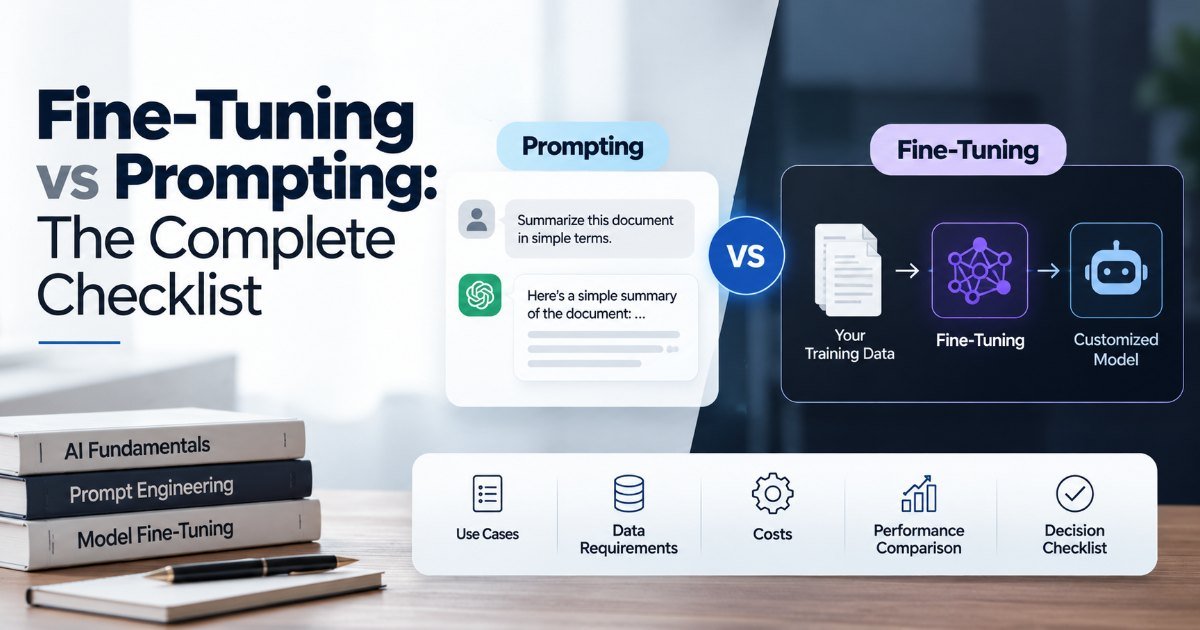
You just watched your teammate ship a chatbot that answers support tickets in seconds. Two weeks later, your boss asks you to build the same thing. You start reading about fine-tuning vs prompting and suddenly you're drowning in jargon. Here's the thing: most of that noise is just people picking sides. The real question is simpler — what does your actual problem need?
Let me give you my honest take up front. Prompting wins more often than it gets credit for. Fine-tuning wins when the stakes are high and the data exists. The mistake I see most often is fine-tuning a model that a good prompt would have handled just fine. (I've done it myself. It burned a week of my life and two grand in cloud credits.)
When prompting is actually enough
Prompting — crafting instructions, examples, and context that tell the model what to do — is the first thing everyone tries, and it shouldn't be dismissed as a beginner's shortcut. A well-structured prompt with a handful of examples (that's "few-shot learning") can get you remarkably far. GPT-4o, Claude, Gemini — they all respond to good prompting with genuinely useful output.
The sweet spot for prompting is when your task is well-defined, the model already knows the domain, and you need to change behavior without retraining anything. Think: tone adjustment, formatting, classification into known categories, summarization. You can ship it today. That's not nothing — speed is a feature.
Three signs prompting is your answer:
- Your task is a variation on something the model already does well.
- You don't have hundreds of labeled examples — and honestly, you probably don't need them.
- You want to iterate fast. Change a prompt and test it in minutes. Try that with a training run.
When you actually need to fine-tune
So when is it actually time to fine-tune an LLM? Fine-tuning is training a pre-trained model on your specific data so it internalizes your domain. It's not magic and it's not cheap. OpenAI's gpt-4o-mini fine-tuning runs a few dollars per million tokens for training input, and that's before you count the people who curate the data. The payoff comes when prompting can't get you there.
You need fine-tuning when the model keeps getting the same thing subtly wrong, and no amount of prompt engineering fixes it. That usually means the knowledge lives in your data, not in the model's training set. Proprietary terminology, internal policies, product lines that launched last month — the model literally cannot know these without exposure.
The classic case is a support bot that needs to quote your company's specific return policy verbatim. Prompting gets you 80% there. Fine-tuning gets you the last 20% — the part that actually prevents an angry customer from being told the wrong thing.
Fine-tuning vs prompting: how to decide
Before you spend a dollar on compute or a week on data, run through these. I'm serious — print this out if you want.
How much labeled data do you actually have? Fine-tuning needs real examples. A few dozen might work for simple tasks. For anything nuanced, you want hundreds, ideally thousands. If you're staring at a spreadsheet with 40 rows, you're not ready.
How specific is the knowledge? Generic stuff — "write friendly emails" — prompting handles it. Domain-specific stuff — "explain our SaaS pricing tiers to enterprise buyers" — that's fine-tuning territory.
How often does the output need to change? Prompts are editable in seconds. Fine-tuning requires a new training run. If your requirements shift weekly, fine-tuning will make you miserable.
What's your budget and timeline? Prompting: nearly free to a few hundred dollars a month. Fine-tuning: data engineering, GPU time, evaluation, iteration. Realistically, thousands of dollars before you see stable results.
Do you control the data? If your training examples contain customer PII or proprietary info, you may not be allowed to send them to a third-party API. That rules out cloud fine-tuning and points you toward on-prem or open-source models.
How do you measure success? If "good enough" gets you to launch, prompt. If you need 95%+ accuracy on a compliance-sensitive task, fine-tuning earns its keep.
Have you tried RAG first? In the RAG vs fine-tuning choice, retrieval-augmented generation feeds your model the relevant documents at inference time. It's often the middle ground — cheaper than fine-tuning, more accurate than a bare prompt. Don't skip it.
A quick comparison table
| Scenario | Best approach | Why |
|---|---|---|
| Change the model's tone | Prompting | Behavior change, no retraining |
| Answer questions about your products | RAG or prompting | Knowledge is in your docs, not the model |
| Classify tickets into 10 known categories | Prompting | Well-defined, model already knows the domain |
| Generate legal docs in your firm's style | Fine-tuning | Style and terminology are highly specific |
| A task the model fails at consistently | Fine-tuning | Prompting has hit its ceiling |
My recommendation, plainly
Start with prompting. Get something working, measure it, and only move to fine-tuning when the data proves you have to. I've watched teams burn months on fine-tuning projects that a better prompt would have solved in an afternoon. The models are good now — good enough that the bottleneck is usually your data and your judgment, not the weights.
One caveat: if you're building a consumer-facing product where every response matters and you have the data, fine-tuning is worth the investment. The difference between 90% and 97% accuracy is the difference between a demo and a product people trust.
Key Takeaways
- Prompting is fast, cheap, and flexible — start there for most tasks.
- Fine-tuning earns its cost when knowledge is proprietary, specific, and high-stakes.
- The biggest mistake is fine-tuning before you've exhausted prompt engineering.
- RAG sits between them and deserves a look before you commit to training.
- Your data quality matters more than your model choice — garbage in, garbage out, always.
- Measure before you invest. If prompting hits 85% accuracy and your bar is 90%, think hard before paying for fine-tuning.
Frequently Asked Questions
Is fine-tuning worth it in 2026? It depends on your data and your stakes. If you have hundreds of high-quality examples and a task where small errors are expensive, yes — the ROI shows up fast. If you're tweaking tone or handling a handful of well-defined categories, prompting will get you there for a fraction of the cost. Run the checklist above before you commit.
How much data do I need to fine-tune an LLM? There's no magic number, but as a rough guide: simple classification tasks can work with a few dozen examples, while complex generation or reasoning tasks want hundreds to thousands. Quality beats quantity — 200 clean, well-curated examples often beat 2,000 noisy ones. If you don't have that much, prompt or use RAG instead.
What's the difference between prompt engineering and fine-tuning? Prompt engineering shapes how the model behaves through instructions and examples at inference time — no training involved. Fine-tuning actually retrains the model on your data, baking your domain knowledge into the weights. Prompting is editing the conversation; fine-tuning is teaching the model a new skill. Use prompting first, and only fine-tune when prompting can't close the gap.
How did this story feel?
Be the first to react
Written by
TechPulse Team
The TechPulse editorial team publishes clear, practical technology guides. Every article is original and written to be understood — not just skimmed.
Comments (0)
No comments yet — start the conversation!
Keep reading

Why Data Quality Matters More Than the Algorithm
Your model passed every test. The data didn't. Why data quality matters more than the algorithm, with real examples from Tay to retail and healthcare models.

How Chatbots Remember — And the Mistakes You're Making
You're three messages into a chat with an AI assistant. You tell it your dog's name, your goto coffee order, and the deadline for that big project. You close…

Machine Learning Basics Without the Math Panic
You don't need advanced math to understand machine learning. Here are the mistakes most beginners make — and what to focus on instead.