
Why AI Benchmarks Often Mislead You
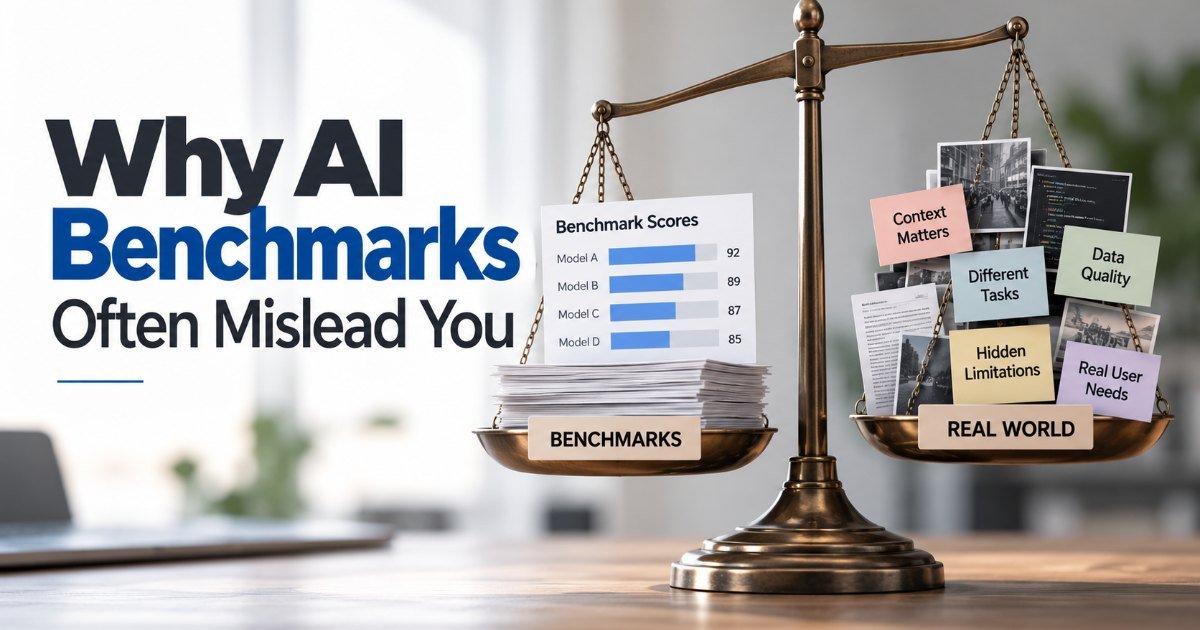
AI benchmarks promise a quick way to compare models, but they often hide more than they reveal. You've probably seen a headline boasting that a new model "beats" the previous champion on some leaderboard. The excitement is real—until you dig into how that number was produced. (I've seen this happen with a popular image classifier.)
Understanding AI benchmarks
At their core, AI benchmarks are standardized tests. They feed a model a fixed set of inputs, then measure outputs against a human‑labeled ground truth. Sounds fair, right? The catch is that the test set is a snapshot, not a living sample of the world.
The trap of benchmark overfitting
When teams tune hyperparameters on the exact dataset used for evaluation, they're essentially memorizing the test. This is benchmark overfitting, and it inflates scores without improving real‑world ability. You'll see models that score 99% on a paper but stumble on a slightly different prompt.
Why model evaluation matters
A single number can't capture nuance. Model evaluation should look at error types, robustness across domains, and latency. Relying on one metric is like judging a car by its top speed alone.
AI performance metrics can lie
Some metrics, like accuracy, reward models that guess the most common label. In imbalanced datasets, a trivial classifier can achieve high accuracy while being useless. Always check precision, recall, and the confusion matrix.
From synthetic benchmarks to real-world testing
Synthetic benchmarks are useful for quick comparisons, but they often lack the messiness of real data. Real-world testing exposes a model to diverse accents, edge cases, and adversarial inputs. A model that shines on a clean benchmark may collapse in production.
A quick checklist
- Look at the dataset size and diversity.
- Check whether the test set was used during training.
- Review the metric: is it accuracy, F1, or something else?
- See if the paper reports variance across multiple runs.
- Try the model on your own data before trusting the score.
Key Takeaways
- Benchmarks are snapshots, not guarantees of real‑world performance.
- Overfitting to a test set can produce misleadingly high scores.
- Multiple metrics give a fuller picture than a single number.
- Always validate on data that resembles your use case.
- Treat leaderboard rankings as a starting point, not a final verdict.
Frequently Asked Questions
Are AI benchmarks reliable? They can be, but only if you know how they were built. A benchmark that uses a small, homogenous dataset may not reflect the variety you'll encounter.
How do I know if a benchmark is trustworthy? Look for details on data collection, annotation quality, and whether the test set was held out from training. Papers that disclose these steps tend to be more credible.
What is benchmark overfitting and why does it matter? It happens when a model is tuned on the exact evaluation data, inflating its score. The result is a model that performs well on paper but fails in practice.
How did this story feel?
Be the first to react
Written by
TechPulse Team
The TechPulse editorial team publishes clear, practical technology guides. Every article is original and written to be understood — not just skimmed.
Comments (0)
No comments yet — start the conversation!
Keep reading

Why Data Quality Matters More Than the Algorithm
Your model passed every test. The data didn't. Why data quality matters more than the algorithm, with real examples from Tay to retail and healthcare models.

How Chatbots Remember — And the Mistakes You're Making
You're three messages into a chat with an AI assistant. You tell it your dog's name, your goto coffee order, and the deadline for that big project. You close…

Machine Learning Basics Without the Math Panic
You don't need advanced math to understand machine learning. Here are the mistakes most beginners make — and what to focus on instead.