
North Korea Drones: Kim Pushes AI and Autonomous Warfare
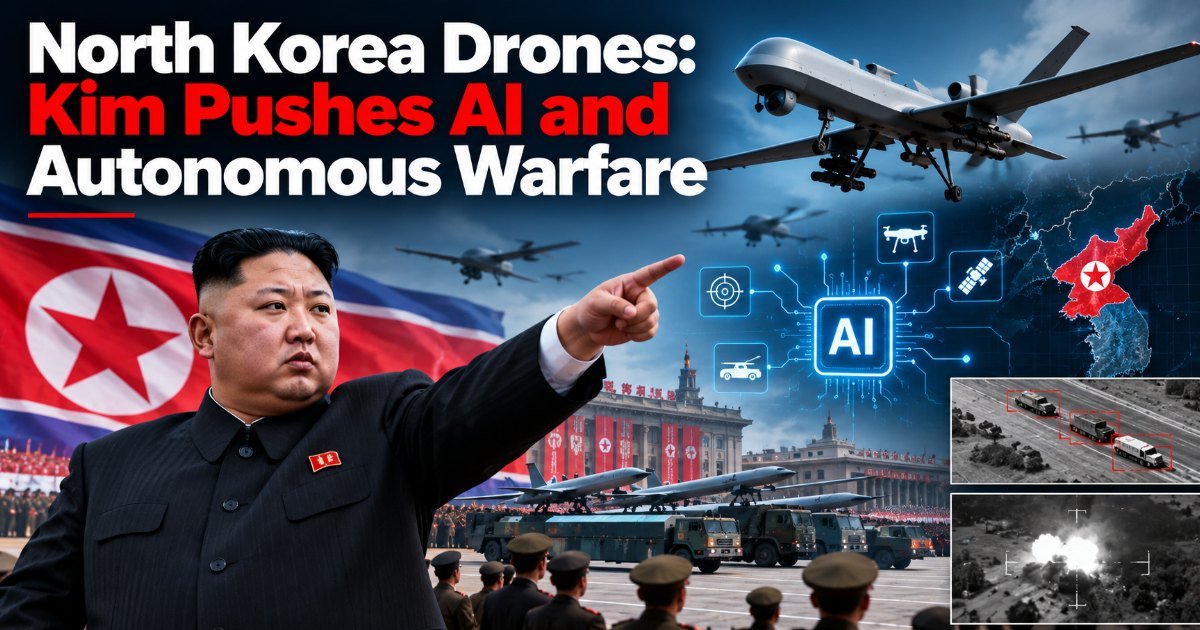
Kim Jong Un wants North Korea's military to own the skies. On Thursday, state media reported the leader called for building drone dominance and weaving artificial intelligence deeper into the country's armed forces — a signal that Pyongyang sees cheap, autonomous machines as the future of war. The push to field North Korea drones is an attempt to get in on that game before the window closes.
Here's the plain version: North Korea is betting that swarms of drones and AI-assisted military systems can offset the firepower of its better-equipped adversaries. It's a bet that makes sense if you've watched what drones have done in Ukraine, Gaza, and elsewhere over the last few years. Cheap commercial and military drones have repeatedly punched above their weight, disrupting supply lines, spotting targets, and even sinking ships. Kim's push is an attempt to catch up — and maybe to scare — before the technology moves on.
Why it matters to you, even if you don't live on a peninsula: this is where defense spending is heading, and that has ripple effects. The countries that master affordable drone swarms and AI targeting will shape the next generation of military doctrine — and the technology that trickles down from those programs eventually shows up in civilian life. Autonomous navigation, edge computing, sensor fusion: these all started as defense projects. The more nations chase this, the more the civilian market gets pulled along.
What Kim Wants From North Korea Drones
According to the Reuters report, Kim stressed the need to "dominate the battlefield with drones" and to accelerate the military's AI capabilities. The remarks came during a meeting focused on the country's defense science and technology development. State-run news agencies framed it as part of a broader push to modernize an army that still relies heavily on Cold War-era hardware.
The specific claims — how many drones North Korea has, what range they can fly, whether they're genuinely autonomous — remain murky. Pyongyang is famously opaque about its weapons programs, and independent verification is nearly impossible. Treat the details as unproven and the direction of travel as the more reliable signal.
Why Drones, and Why Now
North Korea has been developing unmanned aircraft for years, but the timing of Kim's latest emphasis isn't random. Three things converged.
First, the war in Ukraine has been a live-fire demonstration of what drones can do. Cheap first-person-view quadcopters have become a staple of both sides' tactics, and the lesson is hard to miss: a $500 drone can destroy a $5 million tank. North Korea is watching the same footage everyone else is.
Second, the border situation with South Korea has been tense. Pyongyang has been conducting provocative missile tests and flying drones across the demilitarized zone, which Seoul has protested. Ramping up drone capability is both a deterrent and a bargaining chip.
Third, AI has moved from research labs to real-world deployment. The barrier to building "smart" military systems has dropped enough that even a sanctioned, mid-income economy can attempt it — at least in principle. Kim wants to avoid being left behind in that transition.
The Honest Comparison
It's worth being clear-eyed about what North Korea is and isn't capable of. Its drone fleet is not going to rival the systems fielded by the United States, Israel, or China anytime soon. Supply chain restrictions, a lack of advanced manufacturing, and limited testing opportunities mean its hardware likely lags behind the global leaders.
But lagging behind doesn't mean harmless. A drone program doesn't need to be world-class to be effective in the right context. North Korea's terrain, its proximity to Seoul, and its willingness to escalate asymmetrically mean even modest drone capability changes the calculus for deterrence and border security. And North Korea has a history of underpromising and overdelivering on weapons — the missile program is the obvious example.
What to Watch Next
A few things are worth tracking. The first is whether North Korea actually fields new drone systems in exercises or deployments, rather than just announcing ambitions. Words in a speech are cheap; flight tests and production runs are not.
The second is how other militaries respond. If Pyongyang's drone push spurs Seoul, Tokyo, or Washington to accelerate their own programs, that's a story about arms racing, not just about one country's modernization.
The third is the civilian spillover. If North Korea does develop advanced navigation or sensor technology for military use, some of it could eventually leak into commercial applications — the same way early GPS and the internet did. That's speculative, but it's the kind of connection worth keeping in mind.
The bottom line: Kim's drone and AI push is real, but it's part of a long-running effort to make a smaller force more dangerous, not a sudden transformation. The technology matters, but so does the geopolitics. Watch the tests, not the rhetoric.
Key Takeaways
- North Korea's Kim has called for drone dominance and greater military AI use, reported by Reuters amid border tensions with South Korea.
- The push reflects lessons from recent conflicts like Ukraine, where low-cost drones have proven effective against expensive hardware.
- North Korea's actual drone capabilities likely lag behind the U.S., China, and Israel, but even modest systems change deterrence calculations.
- Independent verification is nearly impossible, so treat specific claims from Pyongyang with skepticism.
- The broader trend — affordable autonomous military systems — is what to watch, along with how neighbors respond.
Frequently Asked Questions
What is North Korea's current drone capability? Independent analysts assess North Korea's drone fleet as operationally limited compared to global leaders, with older airframes and less advanced autonomy. However, the country has demonstrated reconnaissance and attack-capable drones, and even basic systems pose a threat near the border.
Why is Kim emphasizing drones and AI now? Kim's emphasis coincides with lessons from recent conflicts like Ukraine, where low-cost drones reshaped tactics, and with heightened tensions along the Korean border. The push is also part of a broader military modernization effort.
Could North Korea's drone program affect civilian life? Directly, probably not. But the competition over drone and AI technology drives innovation in navigation, sensors, and automation that eventually reaches consumer products.
How did this story feel?
Be the first to react
Written by
TechPulse Team
The TechPulse editorial team publishes clear, practical technology guides. Every article is original and written to be understood — not just skimmed.
Comments (0)
No comments yet — start the conversation!
Keep reading

Why Data Quality Matters More Than the Algorithm
Your model passed every test. The data didn't. Why data quality matters more than the algorithm, with real examples from Tay to retail and healthcare models.

How Chatbots Remember — And the Mistakes You're Making
You're three messages into a chat with an AI assistant. You tell it your dog's name, your goto coffee order, and the deadline for that big project. You close…

Machine Learning Basics Without the Math Panic
You don't need advanced math to understand machine learning. Here are the mistakes most beginners make — and what to focus on instead.